

Hi fellow board game enthusiast! After months of work, we've finally launched version 1 of Board Game Verdict, a review aggregator built to help you find your next favourite game. Here's a quick tour of what it is, why we built it, and how it works.
Why we built it
We're recent inductees into the wonderful world of board games (a byproduct of wanting to connect more with people after the pandemic). We remember how lost we felt taking our first steps into this seemingly infinite hobby. Where do we find good reviews? Who should we trust? Is BGG's top 100 where I should start? (we don't necessarily think so).
Around 5,000 board games are released every year, so finding the one that'll make your group, your partner, or just yourself (hi, solo gamers!) go "woah" can be daunting. We combined our team's design and entrepreneurial strengths to build BGV and see if it resonates with the community. We'd genuinely love to hear what you think.
What's Board Game Verdict?
At its core, BGV is a discovery tool. We gather professional reviews from hundreds of credible sources, then normalize and average their scores into a single rating out of 100. We call it The Verdict: a reflection of how a game is judged by a cohort of established critics. Each game also gets a red, yellow, or green badge for an at-a-glance sense of its reception, plus the main things reviewers praised and the things they didn't.
 If you're a movie or video game fan, yes, think Metacritic but for board games. We can roll with that.
Our classification system
Board game terminology runs deep, and labels often mean different things to different people (we're honestly not sure what a Euro game is anymore). We've tried to streamline things so newcomers can find their footing. Here's how we classify games:
Styles: How is it played? Competitive, co-op, team-based, or solo. This is our primary classification, followed by Category.
 Categories: What kind of game is it? Deep, complex games go under Strategy (yes, that's where Euro games live), quick group games are Party, Family games are self-explanatory, and so on.
 Complexity: How much brain juice does it demand? Sometimes called "weight."
 Length: How long does an average game take? This usually excludes rules explanation (ahem, we're looking at you, Root88). Newcomers tend to land at the upper end of the range.
 Player count: A game for 2 to 4 players shows as "2–4"; one designed strictly for 2 or 4 reads as "2, 4."
 Age: The publisher's suggested minimum age. (But hey, if your toddler is Einstein reincarnated, feel free to break out Gloomhaven89.)
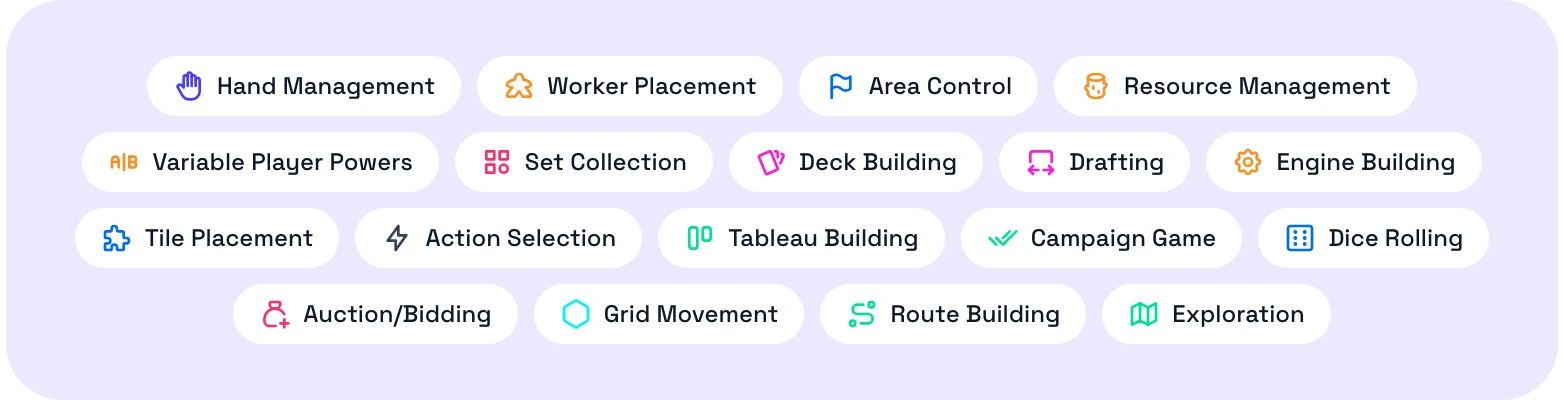
Mechanisms: The core systems that drive play. We surface only the most relevant, easily understood ones, because we're not trying to catalogue every micro-spec. BoardGameGeek already does that beautifully.
 We also credit each game's designers, artists, and publishers, along with its release date, so you can filter by any of them.
Find critics who share your taste
We want to celebrate the rich ecosystem of board game reviewers, so every game shows the individual reviews behind its Verdict: the source, the author, and a short quote. Click any quote to read the original review and discover reviewers you click with. We're also building a tool to show, at a glance, what kinds of games an outlet tends to review and where its leanings are, so you can find critics who align with your taste. More on that soon.
What BGV isn't
We're not trying to be the canonical source of information on every board game ever made. There's already an amazing resource for that: BoardGameGeek, which you might already know and love (we consult it almost every day).
BGV simply approaches discovery from a different angle. BGG's scores are driven by user ratings: an incredible and passionate dataset, but one with a few well-known quirks that can muddy discovery for newcomers. Professional review aggregation offers a complementary signal:
| User ratings tend to… | …while critic aggregation adds |
|---|---|
| Skew toward hardcore hobbyists. BGG's most active raters own hundreds of games and follow the meta, which can inflate complex "gamery" titles and undervalue accessible, mainstream ones. | A more representative pool. Critics review a broad range of games systematically, not just the ones they personally backed or are hyped about. |
| Reflect recency and hype. New releases get flooded with ratings from invested backers, spiking before the wider community has played them. | A consistent reference frame. A critic who has reviewed hundreds of games scores more consistently over time. |
| Carry collection bias. People rate games they own but have played little, so ratings can reflect ownership as much as play. | Sustained play and accountability. Published reviews carry a byline and a reputation, and usually follow real, repeated play rather than day-one impressions. |
| Lack an editorial floor. Anyone can rate without having played, with no disclosure or accountability. | Articulated reasoning. Most reviews explain why a game scores the way it does, giving the aggregate more interpretive grounding. |
| Cluster around consensus. Beloved voices and big YouTubers create a halo effect; nuanced takes get drowned out. | Audience diversity. Some outlets cater to families, some to hobbyists, some to casual players, so aggregating across them softens any single bias. |
None of this is a knock on BGG, which we love. Our concern is just the compounded effect these quirks can have on discovery. In a hobby that's matured as much as board games have over the last 20 years, there's room for many sources, especially ones that bring something new. To keep the movie parallel going: we're Metacritic to BGG's IMDb. Both can coexist and serve different roles.
Our methodology
To build each Verdict, we search the web for credible reviews from established sources and standardize every score to a 100-point scale. Scales with less range get a slight upward adjustment, since we find a 4-star review usually signals more enthusiasm than a flat 80. When a review gives no score, we interpret its sentiment and assign one.
When averaging, we weight each source by its credibility and reach. We believe widely consulted outlets should carry more influence on the final Verdict. Weighting is based mostly on audience size, but also on pedigree: a review in The New York Times carries real weight, and the most-consulted board game outlets (think Dice Tower, SU&SD, No Pun Included) carry the most.
House rules
The Verdict can't be bought. No one can purchase a high score or influence our algorithm. We run ads and affiliate links to cover the cost of running the site, but these have no effect on which games we feature or how Verdicts are calculated. If we ever promote a game, we'll clearly label it as paid promotion, separate from our content.
We're a small team, so we use some AI tools to help with gathering reviews and game details. The reviews themselves come from real critics, and every one links back to the original. The judgment calls are ours: which critics count and how much, which games we add, and every list we publish. All of our artwork and the site's design are made in-house by our designer. Here's exactly where AI is and isn't involved.
Questions about any of this? Drop us a message.
What's next
This is just version 1; we want to gather feedback before scaling up, so we're starting with a few hundred games (a drop in the ocean, we know). We plan to add lots more games, new and old, every month and keep evolving the features along the way. We're just getting started.
We'd love your thoughts: ideas, suggestions, questions, anything. Reach us at hello@boardgameverdict.com. We'll read every email and answer as many as we can.
— Gab